

Why your espresso shot and a perfectly seared steak follow the same rule
Dialing in espresso and searing a steak both come down to one thing: respecting the variables in front of you instead of chasing someone else's numbers. Here's the mindset that makes both work.

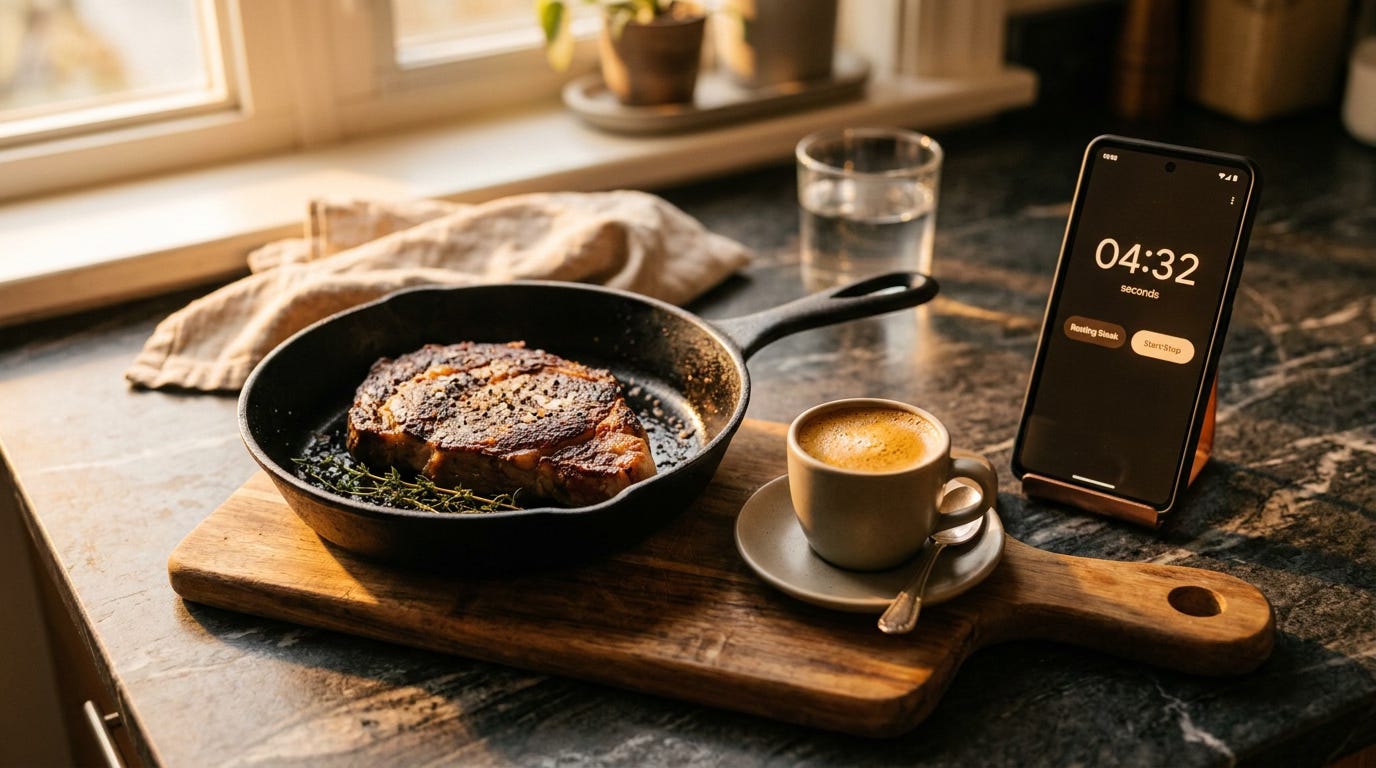
I keep two timers in my kitchen. One is for espresso. The other, lately, is for steak. Somewhere around my third week of using both, I noticed something that should have been obvious from the start: they’re solving the same problem.
Espresso shots and a perfectly seared steak both fail for the same reason. Not because the cook or the barista did something wrong, but because they used someone else’s numbers instead of their own.
If you’ve ever pulled a shot using a recipe from a bag of beans, a video, or a forum post and gotten something sour or bitter that didn’t match what the person on screen described, you already know this. The recipe wasn’t wrong. It just wasn’t yours.
The variable nobody accounts for
Here’s what I mean. A 25-second, 1:2 ratio shot at 200°F (93°C) might be perfect on someone else’s machine, with their grinder, their beans, and their water. Change one of those, and the recipe stops being a recipe. It becomes a starting point you have to adjust from.
Steak works the same way, and it took cooking countless mediocre steaks to see it clearly. A “3-3-2-2” sear (three minutes a side, then two minutes a side at lower heat, roughly) assumes a specific pan, a specific stove, a specific cut, and a specific thickness. Change the pan from cast iron to stainless, change the stove from gas to induction, change the steak from a thin sirloin to a thick ribeye, and that timing is now a guess dressed up as a number.
This is why I think the timer matters more than the recipe in both cases.
What dialing in actually means
When I talk about dialing in a shot, I’m not talking about finding the right number. I’m talking about building a feedback loop: pull a shot, taste it, adjust the grind or the dose, pull again. The number that finally works is yours, specific to your setup, and it’ll drift again the moment your beans age or the humidity changes.
I built an app called Dial In My Shot for exactly this. It doesn’t hand you a recipe. It walks you through the loop: log your shot, taste it, and get a suggestion for what to change next based on what you tasted. Sour and thin points in one direction. Bitter and harsh points another. Over a few shots, you stop guessing and start narrowing in on your number.
Recently, I built a second app for the other thing I obsess over: steak. It’s called SearLoin, and it does the same job for a sear that the espresso app does for a shot. Instead of handing you a fixed “3-3-2-2” and hoping your stove agrees, it asks what pan you’re using, how hot your stove runs, what cut and thickness you’ve got, and how you like it done. Then it builds a timer around those answers instead of around someone else’s kitchen.
Building both back-to-back made the connection obvious. Neither one is doing anything mysterious. They’re both just refusing to pretend that one number fits every setup and giving you a structure to find your own.
Geek Corner
The reason “someone else’s recipe” so often falls apart on a different setup comes down to thermal mass and contact time. A cast iron pan holds and releases heat differently than stainless or carbon steel; the same way a single boiler espresso machine behaves differently mid-shot than a heat exchanger does. The timing in any recipe is really a stand-in for “how long it takes heat or water to do a specific job on this exact equipment.” Swap the equipment, and the stand-in number stops standing in for anything.
Why this matters more than it sounds
If there’s one thing I’d want a home barista to take from this, it’s that struggling to hit someone else’s numbers isn’t a sign you’re doing it wrong. It’s a sign the numbers were never about you in the first place. The same goes for steak, sourdough, or anything else where a recipe gets treated as gospel instead of a starting point.
Tools that ask about your setup before giving you a number, instead of after, save you the months of trial and error I spent assuming the problem was me. That’s true whether the tool is timing a shot or a sear.
If you’ve gone down this kind of rabbit hole before with your grinder, mapping your grinder’s tick settings is the espresso version of the same exercise: turning a vague dial into numbers that mean something on your machine specifically.
Listening while you brew: “Mattinata” by Andrea Bocelli. Slow, warm, and unhurried, the way a good shot or a good sear deserves to be treated.
If this kind of “stop chasing someone else’s numbers” thinking is useful to you, paid subscriptions are what let me keep writing pieces like this instead of just gear roundups. No pressure, just know it helps.
Have you ever followed a recipe (coffee or otherwise) to the letter and still gotten a result that didn’t match what you expected? What did you change to fix it?
If you know someone who’s been frustrated by “just use this recipe” advice, whether it’s for espresso or for dinner, this one might land for them.
Warmly,
Jim
Pull, Quill, Pour Stories
It is so cool that you made not one but two apps!