

Why Your Espresso Tastes Off Even When You're Dialed In
Same recipe, different shot every time? Your burrs might be crooked, not your dial-in. Here's the test that proves it.

You pull the same shot Tuesday and Thursday. Same beans, same dose, same number on the dial. Tuesday’s clean and sweet. Thursday’s sour on one sip, dry on the next, and you haven’t touched a setting in between.
So you nudge the grind finer, then coarser, then back, hunting for a number that stops existing. But grind inconsistency isn’t always about the setting. Sometimes the two burrs shaping every particle just aren’t sitting parallel. No dial position fixes that.
Nobody checks burr alignment because it’s not a setting you touch. It’s built in, assumed correct. Usually it is, at first. Shipping stress, a dropped hopper, and plain factory tolerance; any of it can leave the burrs a hair off-plane. And that tilt goes around, fooling you into blaming the recipe for months.
What Misaligned Burrs Actually Do to a Shot
Two flat burrs are supposed to sit exactly parallel, spinning close enough to shear beans into a narrow band of sizes. Tilt one burr even slightly, and the gap stops being even all the way around. One side of the ring grinds fine, the other coarse. Both land in the same basket.
Water finds the coarse, low-resistance path first and rushes it. The fine particles nearby sit there getting over-extracted and bitter while the rest of the puck barely gets touched. Sour and bitter in the same sip. Odd combination, until you realize it’s really two extractions happening in one portafilter.
And the fix never sticks, which is the maddening part. Grind finer to slow the fast side; the already-fine side turns to mud and clogs. Grind coarser to fix the mud; the fast side runs through even quicker. You’re not solving anything. Just picking which symptom you’d rather have this week.
The Marker Test: How to Check Alignment at Home
Flat burr grinders only. Gaggia MDF and MDF 55 owners, you’re set; those run flat burrs. Breville Smart Grinder Pro or the built-in grinder on a Barista Express, you’re on conical, and this test won’t give you a clean read since there’s no flat face to ink.
Conical grinders can still misalign, just differently. It shows up as runout, the lower burr’s spinning axis wobbling slightly off-center rather than the whole plane tilting. A dial indicator against the shaft catches that, not a marker. Grind still scattered under a loupe after you’ve ruled out setting and puck prep? Call the manufacturer on that one.
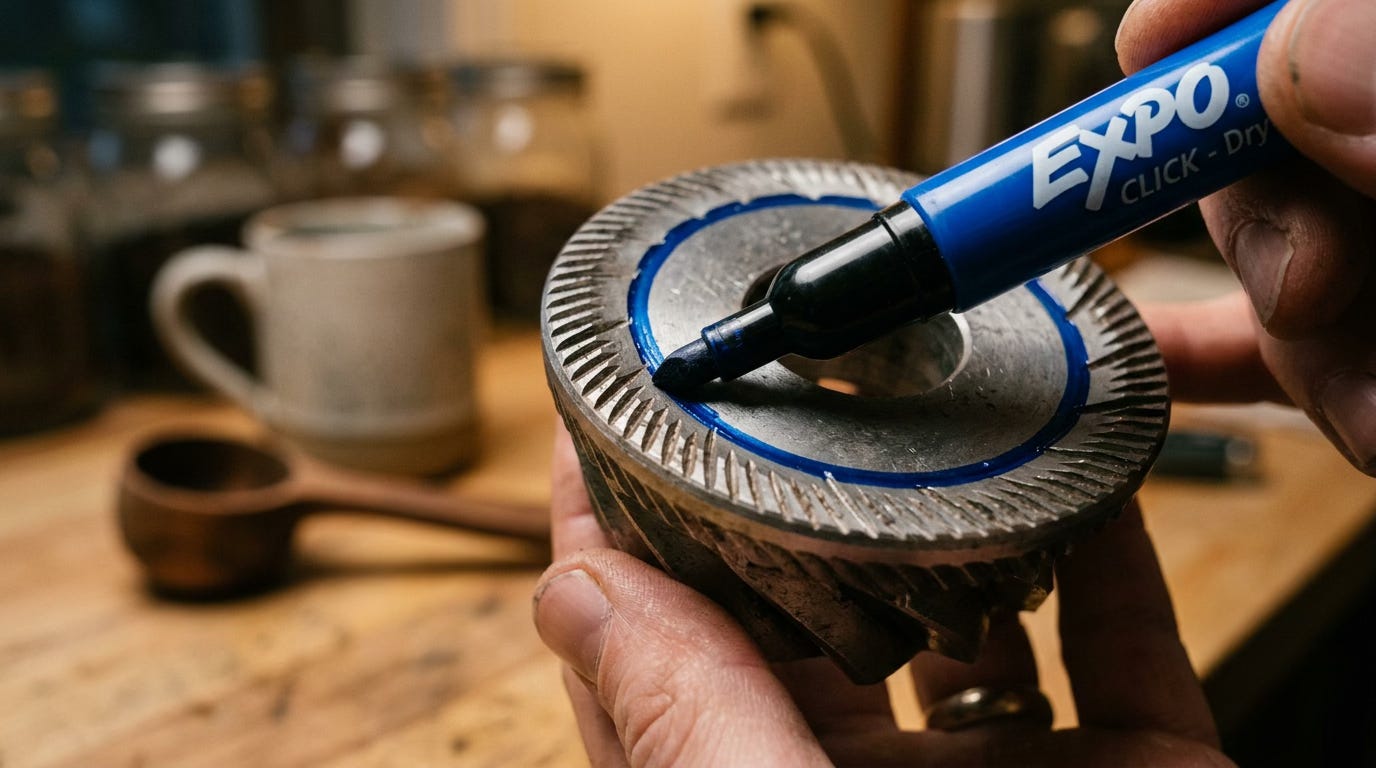
For flat burrs, grab a whiteboard marker, the kind that wipes off a dry-erase board. Ten minutes, start to finish.
Whiteboard marker only. Never permanent. It won’t wipe clean, and a clean wipe is the whole point.
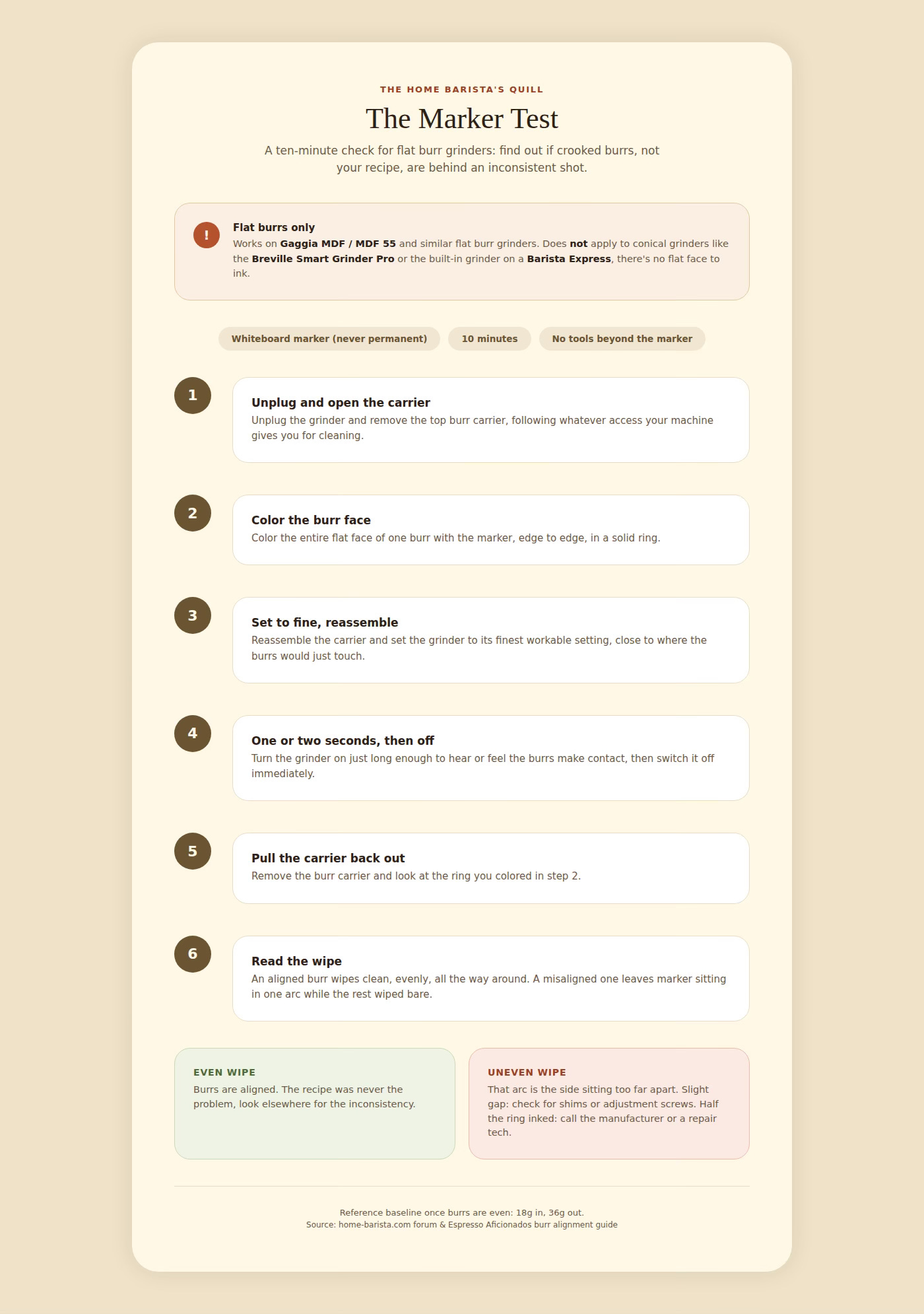
Unplug the grinder and remove the top burr carrier, following whatever access your machine gives you for cleaning.
Color the entire flat face of one burr, edge to edge, solid ring.
Reassemble the carrier and set the grinder to its finest workable setting, close to where the burrs would just touch.
Turn it on for one or two seconds, just long enough to hear the burrs make contact, then off.
Pull the carrier back out. Look at the ring.
Aligned burrs wipe clean, evenly, all the way around. Misaligned ones leave marker sitting in one arc while the rest are wiped bare.
An uneven wipe means that arc is the side sitting too far apart. Ink doesn’t lie, even when your recipe swears it’s fine.
Geek Corner
Alignment fails two ways: axial, where the burrs aren’t parallel front to back, and radial, where the lower burr’s axis wobbles. The marker test catches axial tilt well on flat burrs. Radial runout, more common on conical grinders, needs a dial indicator.
What to Do With an Uneven Wipe
A slightly uneven wipe on an entry-level flat burr grinder is usually adjustable. Some grinders use shims, thin strips added under the low side of the burr mount. Others have built-in adjustment screws. Check what your specific model actually supports before you assume it requires a repair.
Half the ring inked, half bare? That’s past a shim fix, time to message the manufacturer or a repair tech. And don’t crank the grind finer to compensate while you wait, that just wears out the side already doing too much work.
Once the wipe comes back even, go back to your usual recipe. Eighteen in, thirty-six out is still a fine baseline. Only difference now: the number on the dial means the same thing tomorrow that it means today.
If puck prep is still part of your problem alongside alignment, the uneven extraction guide goes deeper on channeling and distribution. And once your burrs are actually even, mapping your grinder’s tick timing turns that evenness into a repeatable number.
Common questions
Does the marker test work on Breville and Gaggia grinders?
Depends on the model. Gaggia MDF and MDF 55 run flat burrs; the test applies directly. Breville Smart Grinder Pro and the Barista Express’s built-in grinder are conical, so it doesn’t.
Can burr misalignment cause espresso to taste different even with the same recipe?
Yes. A misaligned grinder throws a wider spread of particle sizes at the same setting than an aligned one does. Same dose, different extraction, day to day, nothing else changed.
How do I know if my flat burr grinder’s burrs are misaligned?
Run the marker test above. Beats guessing by taste.
How often should I check burr alignment?
Once when the grinder’s new. Again, any time shots drift inconsistently for no reason, or after the grinder’s been jostled or shipped.
Listening while you brew: “Patience” by Take That
A song about not forcing the process, which is basically what a marker test asks of you.
Spotify:
Have you run the marker test on your grinder or found out the hard way that alignment was the real problem? I’d like to hear what you found.
Know someone who keeps re-dialing the same shot with no luck? Send this their way. Might save them a few weeks of guessing.
Warmly,
Jim
Pull, Quill, Pour Stories