

How to Backflush and Descale Your Espresso Machine (Without Breaking a Sweat)
Learn the complete guide to backflushing and descaling your espresso machine. Keep your shots tasting great and your machine running for years.


Your espresso machine is working hard for you every morning, turning beans into liquid gold. But like any loyal workhorse, it needs regular care to keep performing at its best. Two essential maintenance tasks stand between you and years of delicious shots: backflushing and descaling.
Here’s the thing: these aren’t the same process. Backflushing cleans coffee oils and residue from the brew group, while descaling removes mineral buildup from the water system. Both are necessary, and both keep your investment running smoothly. With about 15 minutes of attention every few weeks, you’ll keep your espresso tasting clean and your machine happy.
Why Your Machine Needs Both Backflushing and Descaling
Coffee and water leave behind unwanted guests in your espresso machine.
The Coffee Oil Problem
Every time you pull a shot, oils from your coffee coat the internal surfaces of your brew group. Over time, rancid oils create off-flavors in your espresso—that bitter, burnt taste that makes you wonder if something’s wrong with your beans. It’s not the beans. It’s last month’s shots haunting your cup.
The Mineral Menace
Hard water contains dissolved minerals like calcium and magnesium. When heated inside your machine, these minerals form limescale—a stubborn, chalky buildup that clings to boilers and heating elements. Limescale acts as an insulator, forcing heating elements to work harder and disrupting temperature stability, potentially clogging pipes and damaging components.
Signs Your Machine Needs Attention
Espresso tastes bitter or “off”
Water flow seems slower
Machine takes longer to heat up
Steam pressure feels weaker
Backflushing Explained: Cleaning the Coffee Highway
Backflushing reverses water flow through your machine’s brew group, forcing cleaning solution back up through the shower screen and group head. This dislodges trapped coffee grounds and dissolves oils coating your brewing components.
A water-only backflush can be done daily to prevent buildup. A detergent backflush—using products like Urnex Cafiza or Biocaf—should be done every two weeks for home users or weekly if you’re pulling more than five shots daily.
Important: Only machines with three-way valves can be backflushed. Check your manual if you’re unsure.
Step-by-Step Backflush Guide
What you’ll need:
Blind filter (rubber disc without holes)
Espresso machine cleaner (Cafiza or similar)
Clean cloth
The Process:
Prepare your portafilter. Remove the regular filter basket and insert your blind filter. Add about half a teaspoon of cleaner.
Lock in and cycle. Insert the portafilter into the group head and activate the brew cycle for 10 seconds.
Release and repeat. Stop the cycle, wait 10 seconds for the whoosh, and repeat 5-8 times until you see clean foam in your drip tray.
Rinse the portafilter. Remove it, dump the contents, and rinse thoroughly under the group head’s water stream.
Water-only rinse cycles. Repeat the on-off cycles 5 more times with clean water to flush any remaining detergent.
Final test. Pull a test shot and discard it to ensure no cleaner residue affects your next drink.
I once skipped the water-rinse step after a backflush because I was running late. My next cappuccino tasted like dish soap. Those rinse cycles aren’t optional.
Descaling Demystified: Fighting the Mineral War
Descaling tackles mineral deposits hidden deeper in your machine’s water system—the boiler, heating elements, and internal lines.
Limescale is like cholesterol for your espresso machine. You can’t see it building up, but over time it narrows pathways and causes serious problems.
How Often to Descale
Your descaling frequency depends on water hardness and usage.
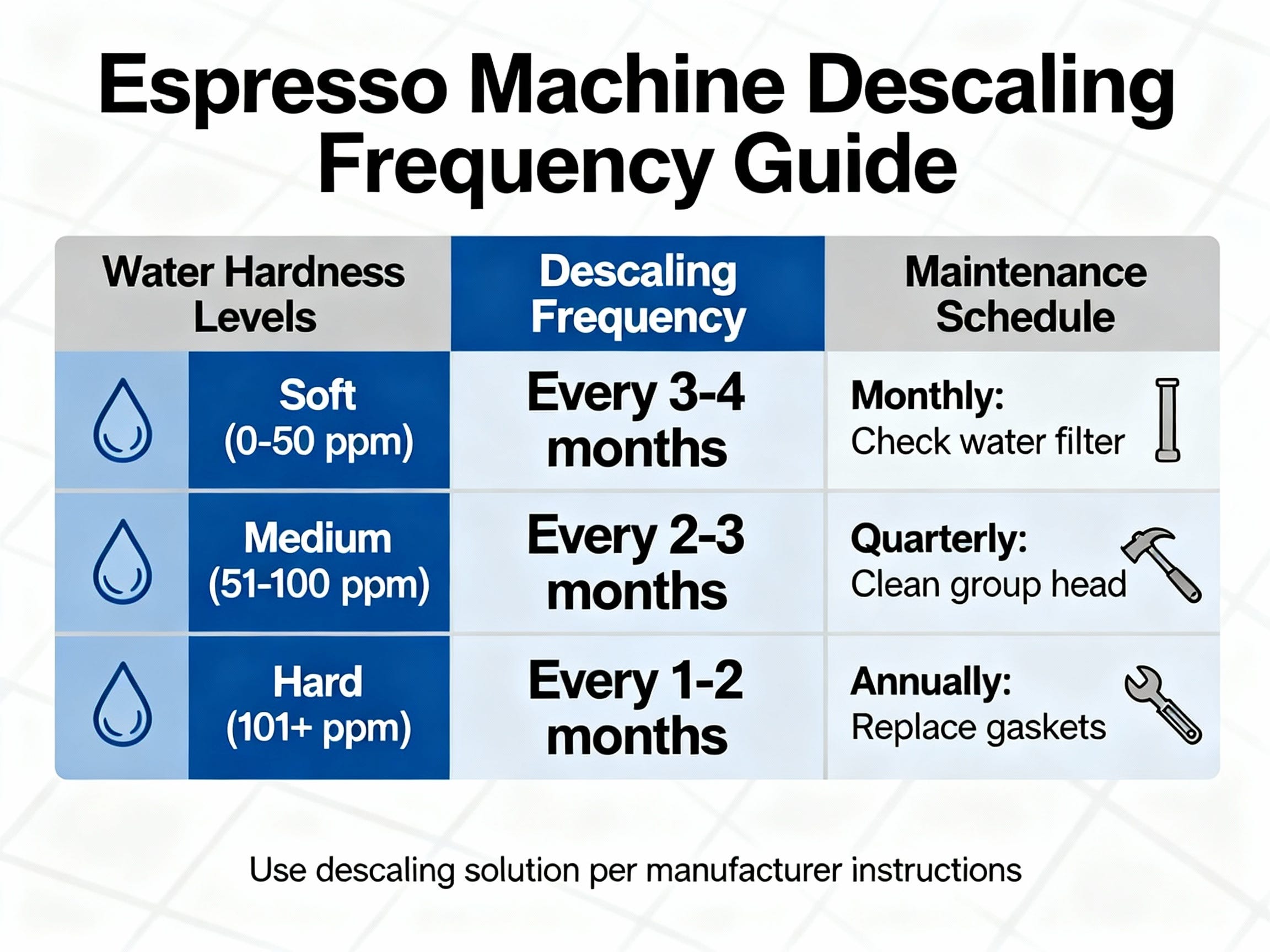
For descaling solutions, commercial descalers are safest. Food-grade citric acid works effectively; mix 1–2 ounces per 64 ounces (ca. 2,419 g) of water. Avoid vinegar; it’s weaker, leaves a stubborn odor, and requires excessive rinsing.
Step-by-Step Descaling Guide
What you’ll need:
Commercial descaler or food-grade citric acid
Large container for catching water
Fresh water for rinsing
The Process:
Prepare the solution. Empty your water reservoir and remove filters. Mix descaling solution according to package directions.
Fill and flush partially. Fill the reservoir with descaling solution. Run about one-quarter through the group head, then one-quarter through the steam wand.
Let it soak. Turn off the machine and let the solution sit for 15–20 minutes to dissolve mineral deposits.
Complete the flush. Run the remaining solution through the group head and steam wand in alternating cycles.
Rinse thoroughly. Fill the reservoir with fresh water and run at least 2-3 full reservoirs through the system until no sour taste remains.
Reassemble and test. Replace water filters if applicable and pull a test shot to verify everything tastes normal.
Conclusion: Your Maintenance Schedule Made Simple
Maintaining your espresso machine doesn’t require a PhD. A simple routine keeps your shots tasting clean and your machine running for years:
Weekly: Water-only backflush (2 minutes)
Every 2–4 weeks: Detergent backflush (10 minutes)
Every 2–4 months: Descale (30–45 minutes)
Set calendar reminders so these tasks don’t slip through the cracks. Your taste buds will notice the difference immediately, and your machine will thank you with years of reliable service.
How long has it been since you last cleaned your espresso machine, and have you noticed changes in taste or performance?
What’s your water hardness level, and does your machine have built-in descale alerts?
Warmly,
Jim
The Home Barista's Quill