

Late-night chess and espresso: a shot before the review
The late-night chess and espresso ritual has a new piece: Ply, a private browser analysis tool with no account, no friction, just Stockfish and the position you need to understand.

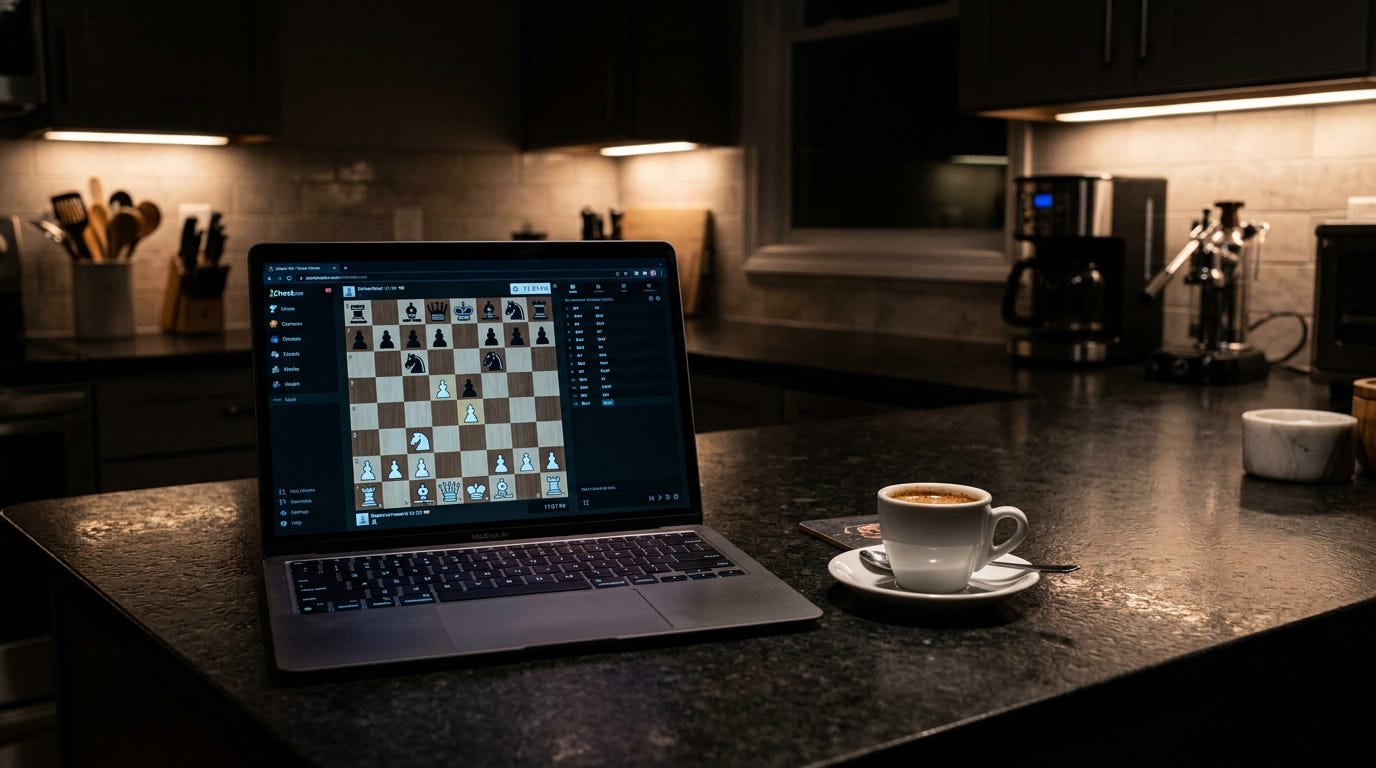
One reader wrote in a few months back: “I play online chess until midnight, and I always want one more espresso, but I can’t justify it.” I’ve been there. The game ends badly; the clock says 11:47 p.m., and something in you wants both answers and caffeine before you’ll let the night close.
There’s a specific kind of late-night espresso that belongs in this conversation. Not the one you pull for company or flavor tourism. The one you pull because you’re still thinking, and the thinking wants company. A short shot, something dark-roasted and forgiving, dialed a little fast so it’s done before the board finishes loading. That shot and late-night chess belong together, which is something I wrote about at length in the espresso and chess piece from earlier this year. The case for the pairing holds. What was missing was a tool that matched the mood.
Why are chess analysis tools bad for late-night review?
Most chess analysis tools are designed to keep you playing, not thinking. Chess.com and Lichess both have built-in game review, but both platforms use it as a re-engagement hook: notifications, accuracy prompts, and next-game nudges that pull you back into the queue. Desktop engines are the other option, but they require setup (binary, GUI, file import) that nobody runs at midnight. Neither tool fits a short, focused review session.
Chess.com and Lichess both have built-in reviews. They work. But they also want you to stay: notifications, next-game prompts, and accuracy scores that funnel you back into another blitz queue. At midnight, that’s a trap. You would rather not play more games. You want to understand the one game you just played, and then you hope to go to bed.
Desktop engines are the other option. They’re accurate and fast. They’re also set-up projects: download the binary, configure a GUI, and point it at a file. Nobody does that at 11:50 p.m. on a weeknight.
What is Ply chess analysis?
Ply is a free, private chess analysis app that runs entirely in your browser with no account or login required. Paste in a PGN from Chess.com or Lichess, or set up any position manually, and Stockfish starts running immediately. It shows up to five engine lines at once with real-time evaluations. Your game data never leaves your device, not as a policy promise but because there’s no backend to send it to.
Ply is a chess analysis app that runs entirely in your browser. No account, no login, no data leaving your device. You open it, paste in a PGN or set up the position you’re still turning over, and Stockfish starts running immediately. Up to five engine lines at once, evaluations updating in real time.
The name is a chess term. One ply is one half-move: White plays; that’s one ply. Black replies, that’s two. It measures search depth, the unit of how far ahead the engine has read. It felt like the right name for a tool built around going one level deeper without making a project of it.
The “no account required” detail is the one that matters most at that hour. Every extra step between you and the board is a reason to skip the review and just go to sleep. Ply has no steps. The board is there when you open the tab.
Geek corner
Ply runs Stockfish via WebAssembly, which means the engine compiles and executes directly in your browser without any server calls. Your games never leave the device, not as a policy promise but as a technical fact. There’s no backend to send them to.
How the late-night ritual actually works
Pull a short shot, paste the PGN into Ply while the crema settles, and find the one move where the evaluation bar swung. Look at two or three engine lines, pick the one adjustment you’d make next time, and stop. You don’t need to work through every inaccuracy. The shot is short; the review should match it. Both espresso and chess reward reviewing one variable at a time. Fix that, then go to bed.
Pull the shot while the last game is still fresh. Something with low acid works better here: a darker roast, a slightly shorter yield, nothing that will put your palate on alert when you just want to think. Paste the PGN into Ply while the crema settles. Find the move where the evaluation bar swung. Look at the two or three lines Stockfish preferred. Sip. Think about the one thing you’d change.
That’s it. You don’t need to work through every inaccuracy. The shot is short, the review should be short, and the night ends with at least one concrete thing learned.
The parallel to dialing in espresso is closer than it sounds. Both practices reward reviewing one variable at a time. A shot that tastes off gives you three possible culprits: dose, grind, and temperature. A lost game usually gives you one moment where the position turned.
The shot teaches you to find that moment and adjust it, not rebuild everything from scratch. Ply is the tool that keeps the chess side of the ritual as clean as the espresso side.
You can find it at ply-chess.netlify.app.
Listening while you brew: “Naima” by John Coltrane. Late, still, and precise: exactly right for the hour.
If you’ve been reading along and finding this kind of writing useful, a paid subscription is what keeps it independent. No sponsored gear, no affiliate pressure on what I recommend. The chess and espresso thread started as one piece; paid subscribers will see where it goes from here.
What does your late-night espresso look like? Dark roast, light, something you keep dialed in specifically for after 10 p.m.? I’m curious whether you pull a dedicated shot for the late session or just use whatever’s left in the hopper.
Know someone who plays online chess and also pulls shots? This one was written for exactly that person.
Warmly,
Jim
Pull, Quill, Pour Stories
My husband is a chess player and an espresso drinker, this app sounds perfect for him!