


We may earn a commission from purchases made through these links at no extra cost to you.
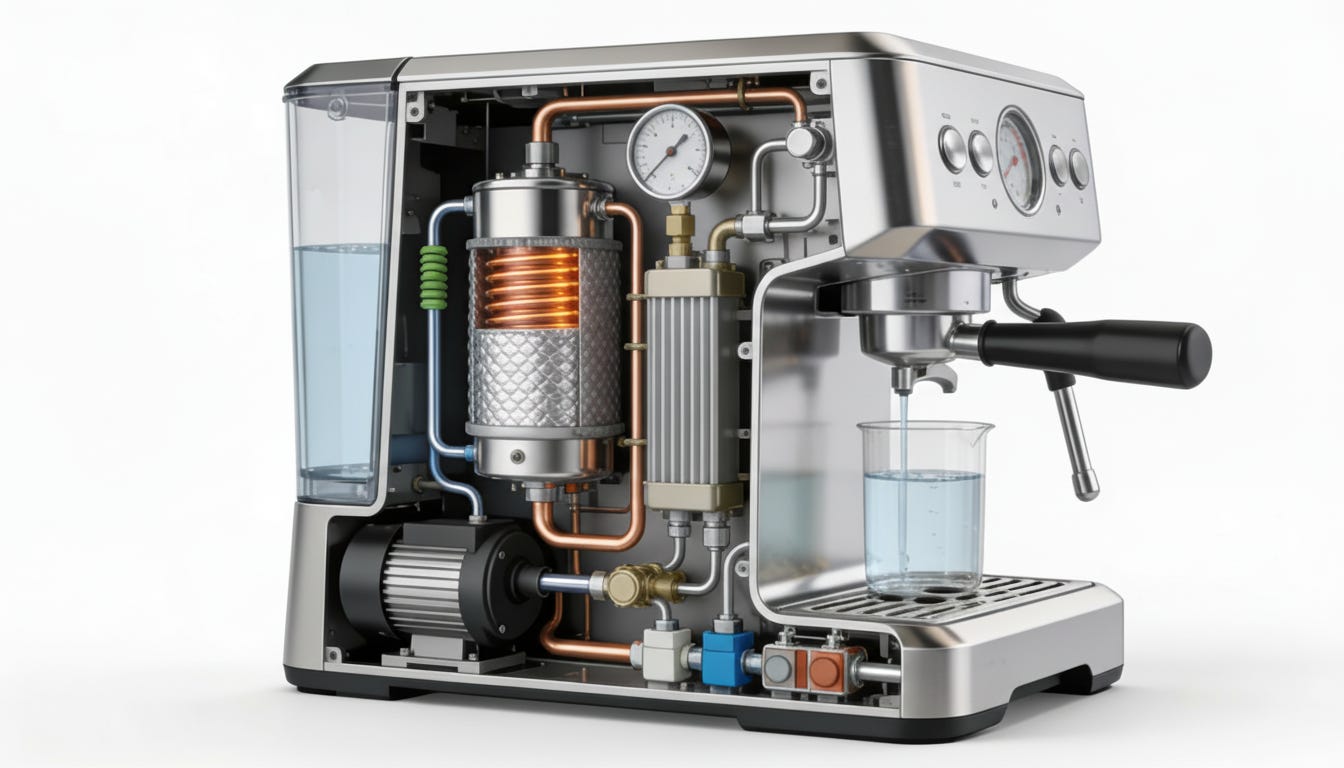
You think your espresso machine hums along fine with a topped-off reservoir and weekly backflushing. But here’s what everyone misses: stale boiler water builds up minerals quietly, dulling flavors and risking scale that can shorten your machine’s life.
One overlooked boiler refresh can turn flat, slightly metallic shots into clean, lively espresso, especially if you already dial in grind and dose with care. This guide walks through why fresh boiler water matters and how to refresh it on two common machine types without ever opening the case.
Reality Check: The Hidden Toll of Stale Boiler Water
Most home baristas obsess over grind tweaks and tamp pressure while the boiler quietly concentrates minerals in the background. Water in the boiler does not fully refresh with every shot. Steaming and hot water use push out some volume, and what remains can get more mineral dense over time.
That concentration shifts taste and can leave milk drinks with a slightly cooked or chalky edge, even when your espresso recipe is on point.
Two Machine Types, Same Problem
Machines with hot water spouts often pull directly from the steam boiler, which means you sometimes taste that stale water in Americanos or tea long before you notice it in espresso.
Heat exchanger machines without a spout route brew water through a tube inside the boiler, so the boiler water still ages even though the brew path sees fresh water from the reservoir.
Over months, that stagnant boiler water plus hard tap water creates the classic scale issues that cause slow warm-up, pressure swings, and costly repairs.
Filter First: Filters such as the BWT Bestsave M Limescale Protection Pad designed to soften water and limit scale, giving your boiler a fighting chance before minerals ever arrive at the heating element.
Why Refresh? Taste, Longevity, and Better Workflow
Fresh boiler water is about more than taste, although taste is usually where you notice the difference first.
The Taste Benefits
When boiler water is refreshed regularly:
Steam power remains consistent
Milk textures stay silky instead of frothy and airy
Flavors in milk drinks feel cleaner and more defined
Many pros and experienced home baristas report that regular boiler purges cut down on strange off-notes that can masquerade as “bad beans” or “weird roast” when the real culprit is old water.
The Mechanical Benefits
On the mechanical side, every time you dilute concentrated boiler water with fresh, low-mineral water, you slow down the rate that scale forms on heating elements and internal surfaces.
That means:
Fewer deep descaling sessions
Lower risk that aggressive descaling eats into gaskets or metals
More forgiving maintenance schedule in harder water areas
A well-matched filter like the BWT Bestsave M Limescale Protection Pad gives you a more forgiving starting point, especially in harder water areas.
Clean the Full Path: A cleaner like Urnex Cafiza is meant for coffee-contact parts such as group heads, portafilters, and screens, not directly inside the boiler water itself. When those surfaces are clear of old coffee oils, your refreshed boiler water supports clarity rather than fighting rancid residue downstream.
💡 The Simple Ritual that Changes Everything
Treat boiler refresh like brushing your teeth. It does not have to be perfect or aggressive; it just needs to be consistent. Small daily purges and weekly deeper refreshes quietly upgrade every drink you make.
Step-by-Step: Machines with a Hot Waterspout
If your machine has a hot water tap, you likely have direct access to the steam boiler. Good examples include many single-boiler, dual-boiler, and prosumer machines with a dedicated tea or Americano spout.
Here is how to refresh that boiler without tools.
1. Start With Better Water
Fill your reservoir with fresh, filtered water, ideally in the range of roughly 50-100 ppm hardness for home brewing.
If your water is harder, consider a solution like the BWT Bestsave M Limescale Protection Pad to soften and stabilize minerals before they hit the boiler.
2. Heat the Machine Fully
Turn the machine on and let it reach full operating temperature for both brew and steam
Give it an extra 5-10 minutes beyond “ready” so the boiler and metalwork stabilize
3. Purge a Chunk of Boiler Water
Place a large mug or pitcher under the hot waterspout
Open the spout fully and run about 8-16 ounces (240-475 milliliters) of water out, depending on your boiler size
Small boilers (around 0.8-1.0 liters): lean closer to 8 ounces (240 milliliters)
Larger boilers (1.5-2.0 liters): Use the higher volume.
You should see the reservoir level drop as the boiler calls for fresh water. That is precisely what you want: old boiler water leaving, new water coming in.
4. Let the Boiler Refill and Recover
Close the spout, then wait a couple of minutes so the pump can refill the boiler
The heater will bring the fresh mix back to temperature
If your machine has a PID, watch until it returns to the set point and stays stable for at least 30 seconds
5. Optional: Second Purge for a Deeper Refresh
For a more thorough refresh, repeat the purge once more with another 8 ounces (240 milliliters). This effectively turns over a large part of the boiler contents without touching a single screw or panel.
6. Confirm With a Quick Taste Test
Draw a small cup of hot water from the spout and taste it once it is cool enough
It should taste clean and neutral, without metallic or “boiled veg” notes that sometimes appear in long-sitting water.
If you still taste something off and you know your water is suitable, it may be time to look at scale buildup and, if needed, a proper descaling product that is designed for boilers.
Keep Groups Clean: Cafiza still plays a role here: run it through your backflush routine at the group head level, so your now fresher boiler water flows through clean passages and does not pick up old coffee residues.
Step-by-Step: Machines Without a Hot Waterspout
Heat exchanger machines and some compact single boilers skip the dedicated hot water tap. Brew water typically travels through a tube inside the steam boiler, so you cannot just open a valve and drain it directly.
Even so, you can refresh the boiler with a combination of steam purges and smart flushing.
1. Build a Daily Steam Purge Habit
Every time you steam milk:
Before steaming: Open the steam wand briefly to purge any condensation and spurts, about 1-2 ounces (30-60 milliliters), into a towel or cup.
After steaming, purge again for a second or two, which pushes a little more freshwater into the boiler as it refills.
This micro-refresh keeps boiler water from going completely stale between deeper maintenance sessions.
2. Weekly Boiler Refresh Using the Steam Wand
Once a week, or more often if you steam heavily:
Start with a full reservoir of filtered or softened water, ideally supported by something like a
Heat the machine fully to steam temperature
Place a large pitcher under the steam wand
Open the wand fully and let steam and water vent until you have expelled around 8 ounces (240 milliliters) for smaller boilers or up to 16 ounces (475 milliliters) for larger boilers
You may see the steam pressure drop temporarily; this is normal while the boiler refills. Let the machine recover, then repeat once if you want a deeper refresh.
What you are doing is similar to the hot waterspout method, just through the wand instead.
3. Complement With Group Flushes
Although the boiler water itself does not pass directly into the group on an HX machine, group flushing after steaming helps stabilize brew temperatures and keep the system circulating.
After your weekly wand purge:
Switch the machine to brew mode
Run 2-4 blank shots of about 2 ounces (60 milliliters) each through the group head into a cup
This ensures fresh reservoir water moves through the heat exchanger tube that sits inside the boiler
Again, this is a no-tools, no-panel method that relies entirely on built-in controls.
How Often Should You Refresh Boiler Water?
The right frequency depends on your water and how you use your machine.
Refresh more Often If:
You steam milk daily, especially large milk volumes
Your local water is moderately hard, and you are not using filtration
You notice a drop in steam performance, odd odors, or cloudy hot water
With Filtered or Softened Water and Moderate Use:
Daily: Tiny steam wand purges before and after steaming
Weekly: 8-16 ounces (240-475 milliliters) boiler refresh via hot water spout or wand
Every 2-3 months: Check your machine manual for any recommended descaling schedule and consider a proper descaling product like Urnex descaling powder if scale is forming
Water solutions like the BWT Bestsave M Limescale Protection Pad system extend these intervals by reducing the mineral load, and that directly means fewer deep maintenance days.
⚠️ Signs Your Boiler Water Needs Attention
You do not need to guess blindly. A few telltale signs say, “Time to refresh.”
Hot water tastes flat, metallic, or slightly sour when cooled
Steam pressure feels inconsistent or weaker than usual at your normal workflow
You notice white or chalky residue around wand tips or inside kettles that share the same water source
Your shots are clean and your grinder is dialed, yet milk drinks carry a strange aftertaste you cannot link to beans or technique
When in doubt, refresh. It is far gentler to prevent scale and off-flavors than to undo them once they are entrenched.
Status Upgrade: From Owner to Caretaker
Once boiler refresh becomes part of your rhythm, you stop seeing your espresso machine as a black-box gadget and start treating it like a small, very capable cafe partner.
Your workflow shifts from putting out fires to maintaining harmony: filtered water going in, boiler water gently renewed, group head kept clean with the help of a dedicated cleaner like Cafiza, and scale kept at bay by smart filtration.
The payoff is simple but profound: fewer surprises, longer machine life, and a cup that tastes the way your beans promise it should.
Subscribe for More
If this kind of quiet, behind-the-scenes maintenance talk helps your shots taste better, you will feel right at home at The Home Barista’s Quill. Subscribe to get weekly espresso guides, gear breakdowns, and coffee stories that make your next pull a little more intentional.
Comment and Share Your Routine
What does your boiler refresh routine look like right now? Have you noticed a flavor shift after purging or changing water? Share your experience or questions in the comments so other home baristas can learn from your experiments too.
Pass It On
Know someone whose machine has great bones but inconsistent results? Send them this guide. A small change in how they treat boiler water might be the missing link between “good enough” and genuinely great espresso at home.
Warmly,
Jim
Pull, Quill, Pour Stories