

Singapore Kopi Recipe: Brew It Right at Home
Tried making kopi at home, and it tasted nothing like what you had in Singapore? Here's what's actually different and how to fix it.

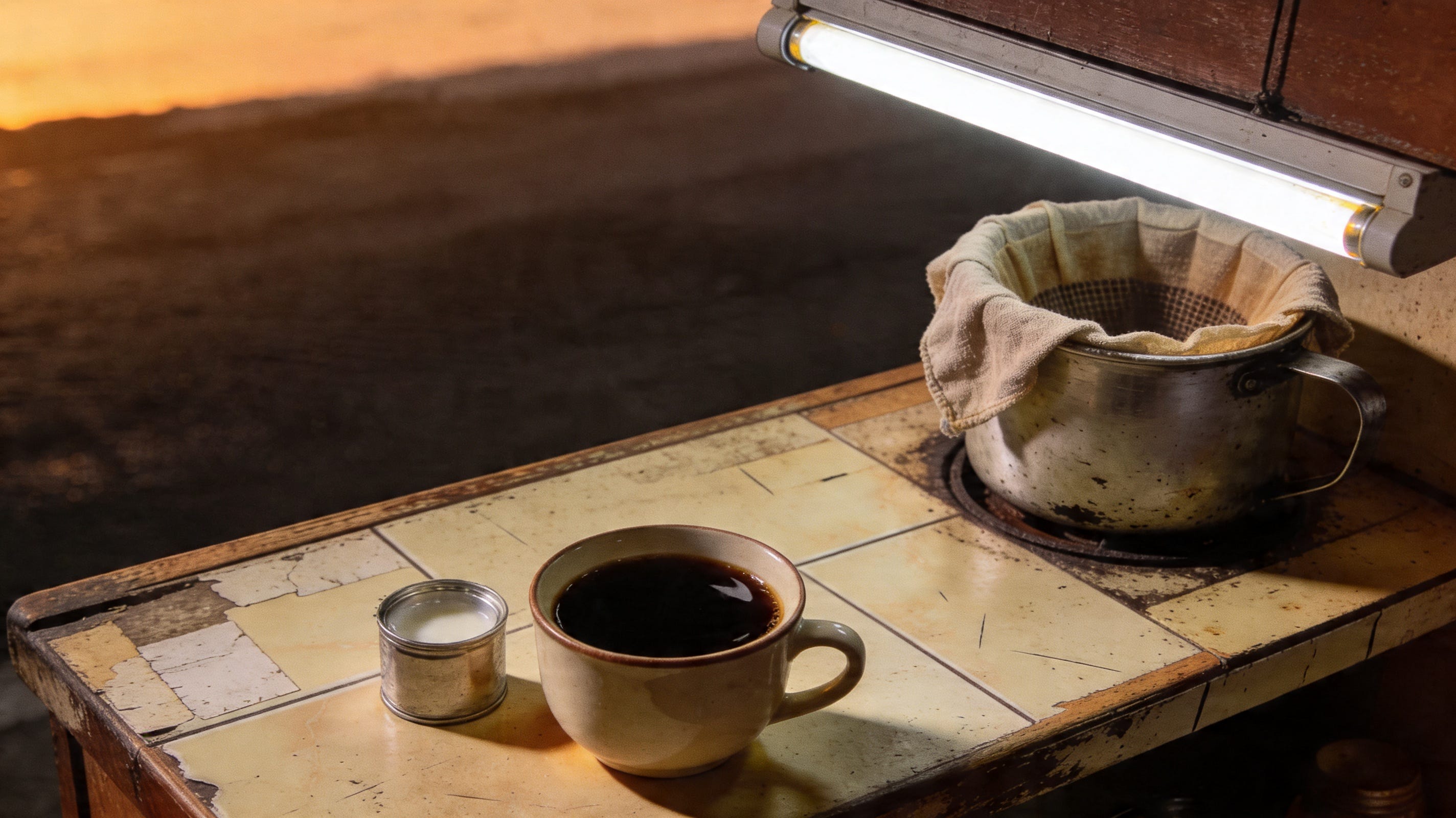
The smell hits before the cup does. At a kopitiam counter at 7 a.m., the air carries something dark and caramelized, faintly smoky, a sweetness baked into the coffee rather than added to it. When you pull your usual shot at home and pour condensed milk over it, that smell isn’t there. The cup tastes thin, too bright, and a little acidic. The problem isn’t your technique or your machine. It’s that you’re starting with the wrong bean entirely.
That’s useful to know, because fixing the starting material is simpler than overhauling a workflow.
What Kopi Actually Is
Singapore kopi is over a hundred years old, built by Hainanese immigrants who needed to make cheap robusta worth drinking. The method they landed on: slow-roast the beans in a wok with caramelized sugar and margarine, add salt partway through, then finish with another pass of sugar for a second caramelized layer. The result is a bean coated in that sweetness, with lower acidity than arabica, a heavier body, and flavors that read as dark toffee, smoked grain, and a faint rubbery depth. Nothing fruity. Nothing floral.
That profile is the whole point. Robusta roasted this way settles into condensed milk rather than fighting it. Arabica pulls in the opposite direction. When you pull a bright, high-acid shot and add sweetened milk, the two compete. Kopi doesn’t compete. It merges.
The traditional roasting ratio is roughly 80% beans to 20% combined sugar and margarine by weight. It’s less a coffee roast than a confection process applied to coffee. You won’t replicate that at home, and you don’t need to. The goal is to source material that has already been through it.
One thing worth knowing before you order: most commercial kopi powders include corn as a filler to reduce cost. Higher-grade options leave it out, and you’ll notice the difference in body and aftertaste. The ingredient list will tell you which you’re looking at.
Finding the Right Powder
Most local roasters won’t carry kopi. That’s the honest constraint upfront. Traditional kopi is sold pre-ground and isn’t designed for espresso machines, which matters when you’re deciding how to brew it.
For sourcing in the U.S., check larger Asian grocery chains like 99 Ranch and H Mart. What you're looking for: a traditional kopi powder with coffee beans, sugar, margarine, and salt in the ingredient list. If corn appears as a filler, that's a lower-grade blend. It's worth checking a few options before settling on one.
Two Honest Brewing Paths
Kopi powder is ground coarser than espresso and wasn’t engineered for a portafilter. Two real options exist, and the one you choose shapes everything downstream. The piece on Master Every Coffee Roast: The Complete Guide to Prepping Each One for Perfect Espresso is worth a quick read before you start; robusta behaves differently under heat and pressure than the arabica most of us brew daily, and that framework helps you stay patient with it.
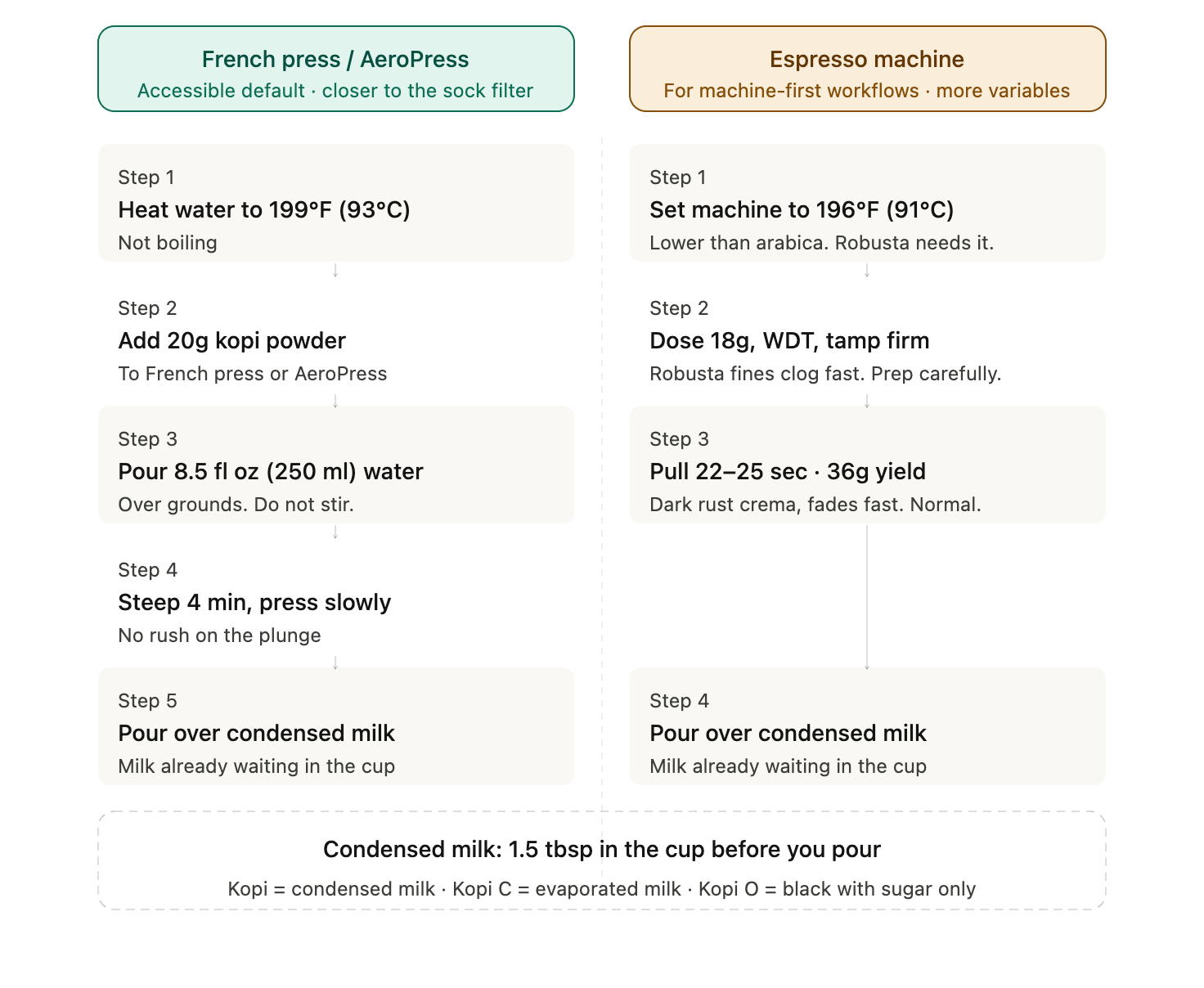
Path one: French press or AeroPress. More forgiving and closer in spirit to the cloth sock filter used at every kopitiam. Immersion brewing suits the coarser grind naturally.
Heat water to 199°F (93°C). Not boiling.
Add 20g of kopi powder to your French press or AeroPress.
Pour 8.5 fl oz (250 ml) of water over the grounds. Don’t stir.
Steep for 4 minutes. Press slowly.
Pour directly over condensed milk already in the cup.
Thick, dark, low-acid. It tastes like kopi.
Path two: espresso machine. Possible, but with real trade-offs. Kopi powder can’t run through most home grinders without clogging them, so you’re working with pre-ground with no grind adjustment available. Robusta also releases fine particles under pressure that pack unpredictably, which makes puck prep more consequential than usual. WDT before tamping helps significantly.
Set your machine to 196°F (91°C). Robusta doesn’t need the heat arabica does.
Dose 18g into the basket. Work it through with a WDT tool, then tamp level and firm.
Pull for 22 to 25 seconds, targeting 36g out.
Pour directly over condensed milk already in the cup.
Expect a dark rust-colored crema that dissipates faster than usual. That’s robusta. Nothing went wrong.
Geek Corner
Robusta has roughly twice the caffeine of arabica and higher chlorogenic acid levels, but the Hainanese roasting process caramelizes away much of the bitterness. The sugar coating raises the effective surface temperature during roasting, producing melanoidins, the compounds behind that dark-toffee character, without scorching the interior. It’s controlled surface manipulation, not a brute-force dark roast.
Getting the Condensed Milk Right
This is where most home attempts fall apart, and the fix is two things: ratio and order.
Put 1.5 tablespoons of sweetened condensed milk in the cup before the coffee arrives. The hot liquid hits the cold, thick milk, and the two combine into something richer than stirring them together afterward ever produces. The temperature differential does real work at that moment.
Three variations are worth knowing: kopi uses condensed milk and is the standard. Kopi C swaps in evaporated milk, lighter, and less sweet. Kopi O is black with sugar only, no milk.
For kopi peng (iced), brew or pull hot as normal, pour over condensed milk in a tall glass, then fill with ice. The sweetness spreads differently as the temperature falls, and the finish lingers longer. On a warm afternoon, it’s the better version.
A Bodum French Press handles the immersion method cleanly. If you want something between a French press and a full espresso pull, a Bialetti Moka Express is worth considering. Robusta’s heavier compounds extract well under the modest pressure a Moka pot delivers, and the result sits closer to what a kopitiam produces than most home setups manage.
Why Kopi Is Worth Understanding
Kopi doesn’t ask to be trendy. A working-class drink that turned a real limitation, cheap robusta, no arabica budget, into a roasting method that produced something genuinely distinct. The technique worked because it had to. A century later, it still does.
There’s something worth sitting with in that. A preparation built on constraint, using sugar and margarine and a cloth filter, producing a cup that holds up on a home counter in 2026. Not every great coffee tradition needs a specialty-roaster origin story to earn your attention.
If pieces like this one are useful to you, consider becoming a paid subscriber. The research behind it, tracing that Hainanese roasting method back to its logic, and understanding why robusta and condensed milk work together the way they do, takes real time. Paid subscribers make it possible to keep writing independently for home baristas. That caramelized smell at the top of the piece didn’t get there accidentally.
What’s your plan: French press first to get the flavor right, or straight into the portafilter to see what happens? Please let me know in the comments.
If you know someone who tried kopi while traveling and never managed to recreate it at home, this one answers the question directly. Worth passing along.
Warmly,
Jim
Pull, Quill, Pour Stories
Some links in this post are affiliate links, which means I may earn a commission if you purchase through them at no extra cost to you.