

Switching to a La Pavoni: What your pump machine never taught you
Making the switch to La Pavoni lever espresso is less about dialing in and more about learning to read a boiler. Here's what to expect.


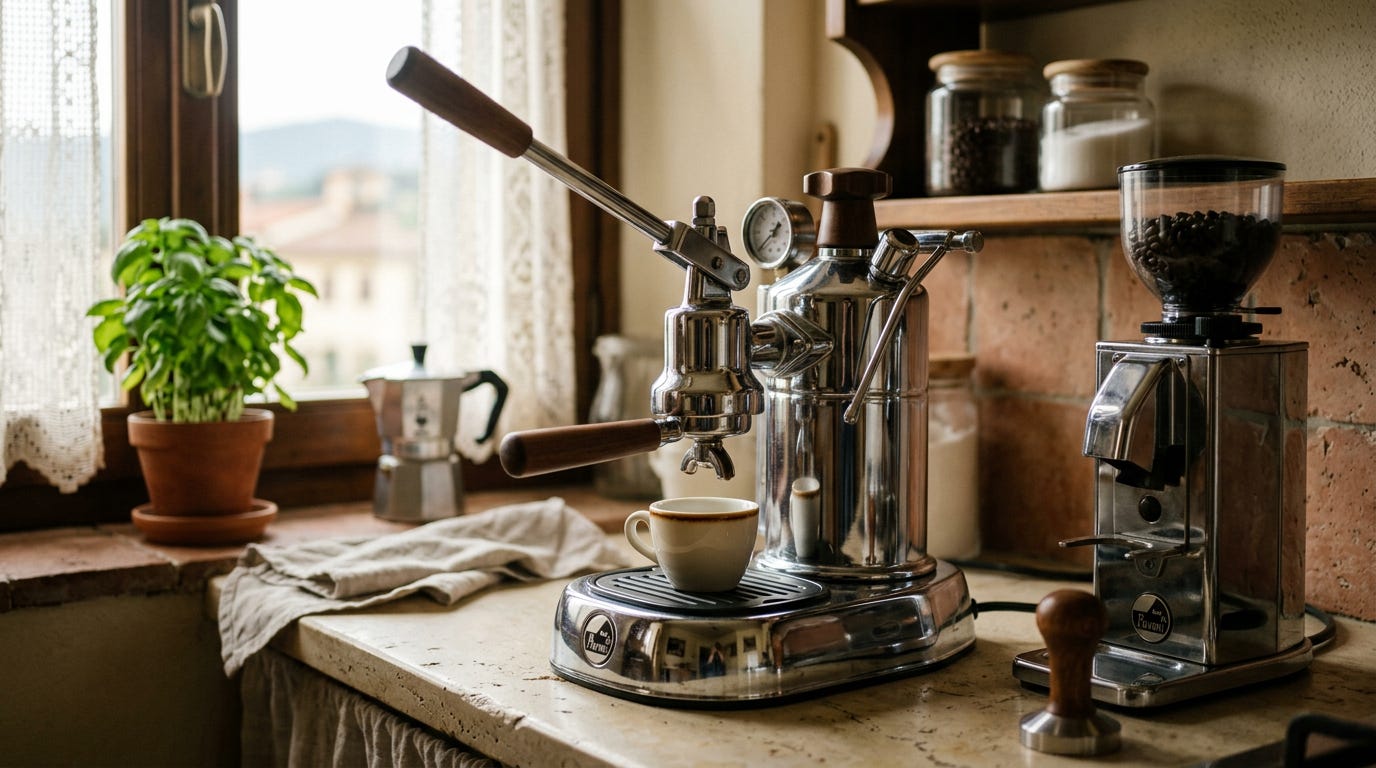
This is a collaboration between Jim Morales of The Home Barista’s Quill and Ella Cusano, an Italian-American gastronome at saporistori.substack.com. The La Pavoni Professional and Jolly Dosalto are hers.
The machine that stares back
Sapori Stori
Growing up, I woke up every morning to the sound of my dad’s espresso machine. It occupied a permanent place on the kitchen counter and, in many ways, felt like his third child. Every morning he would tend to it with a kind of devotion I didn’t understand at the time. He would measure the grounds, tamp them carefully, and pull the shot. I would watch the golden stream cascade into a tiny cup and marvel as velvety milk swirled across the surface. He would take a sip of his little macchiato and smile as though God himself had personally blessed his morning cup.
Years later, when I moved to Italy, I was introduced to a different coffee ritual: the moka pot. My roommates and I would crowd into the kitchen before class and share a pot before rushing out the door. Some mornings, exhausted from studying, I would forget to add the water. Other mornings I would forget the coffee entirely. And washing the moka pot? Forget it. Every Italian seemed to have a different opinion about how not to do it. It took me nearly two years before I felt confident enough to serve a moka coffee to an Italian guest without quietly wondering whether I had committed some unforgivable mistake.
My university roommate—now husband—and I would joke that one day we’d graduate to a real espresso machine. In my mind, I imagined something modern and forgiving, like the machine I had used every morning during my time at Caffè Vergnano. Founded in 1882 in Piedmont, Caffè Vergnano is one of Italy’s oldest coffee roasters, best known for its espresso blends and long history in Italian coffee culture. I wanted something seamless, something a person who was half-conscious at six in the morning could manage.
But then the La Pavoni Professional arrived.
It felt as though Santa had come early. We were finally going to achieve our little dream of owning a “real” espresso machine. Polished chrome, a gleaming brass boiler, and it even had a steam wand—it was stunning. My husband and I immediately began debating which local roaster deserved the honor of the first shot, already imagining leisurely Sunday mornings built around espresso and cornetti.
For a few sweet moments, I simply admired it sitting on the counter, enchanted by the possibilities it seemed to promise.
Then the excitement gave way to a different realization.
I wasn’t looking at a machine that would let me press a few buttons and hand me the perfect cup.
I was looking at a machine that was going to challenge everything I thought I knew about making espresso.
A machine with a century of opinions
Jim Morales
La Pavoni was founded in 1905 by Desiderio Pavoni in a Milan workshop. The Europiccola, the compact home lever most people recognize, arrived in 1961. The Professional followed in 1974: a larger 38 oz (1.1 L) brass boiler, a mounted pressure gauge, and a more deliberate presence on the counter. One of them is in the permanent collection at the Museum of Modern Art in New York, which tells you something about where Italian design priorities sit.
That history matters because the machine hasn’t changed much. The Professional still runs on the same basic logic it did fifty years ago: a single boiler, no pump, no PID, and no pressure profiling. Water heats in the boiler, pressure builds, you lift the lever to flood the group, and you press down to pull the shot. Every variable that a modern semi-automatic handles automatically, the La Pavoni hands back to you.
The Jolly Dosalto is La Pavoni’s own flat-burr doser grinder, made in Milan as part of the same ecosystem. It holds 8.8 oz (250 g) of beans in the top hopper, grinds on stepped flat burrs, and doses ground coffee into the portafilter through a front-mounted dispenser. Using the two together is a deliberate choice, and as Sapori Stori found out, the pairing changes how you think about both.
The first shots and what they cost me
Sapori Stori
I was convinced I was prepared to take on the La Pavoni.
I had read and reread the instruction manual and cleaned the machine not once, but twice, just to be certain everything was ready for the perfect first cup.
As I prepared the portafilter, my husband wandered into the kitchen, equally excited for the inaugural espresso. Together, we followed the instructions step by step. We locked in the portafilter, pulled the lever, and waited for liquid gold to appear.
Instead, a thin stream of pale brown water dribbled into the cup.
Fail.
My confidence evaporated instantly. The chrome machine that had looked so beautiful the night before now felt like a mirror reflecting my incompetence back at me.
My husband picked up the manual again, and together we retraced every step. Had we missed something? Was there a part we misunderstood? At one point, we even convinced ourselves that perhaps we were operating the lever incorrectly. Maybe it was supposed to go up instead of down.
So we tried again.
This time I felt a little resistance. Not much, but enough to give me hope. “Okay,” I thought. “We’re getting somewhere.”
But the shot still wasn’t right. Frustrated and convinced we had made another mistake, we decided to stop, reset everything, and start over from the beginning.
I began removing the portafilter. A small hiss of pressure escaped.
Then silence.
Assuming the machine had fully depressurized, I twisted the portafilter the rest of the way off.
What happened next unfolded faster than my brain could process.
Coffee grounds exploded across the kitchen. A burst of steaming water shot onto my hand. My husband, Guido, froze in disbelief. I froze in disbelief. The machine, meanwhile, seemed entirely unbothered by the chaos it had created.
La Pavoni 1. Ella 0.
Why did those shots lie to you
Jim Morales
Here’s what the pump machine trained you to assume: temperature is managed for you. Dial in the grind, nail the dose, and the machine delivers water at roughly the right temperature every time. The La Pavoni does none of that.
It heats a single boiler to steam pressure. That same boiler is the water source for your shot. Brew water comes off as you lift the lever, and if the boiler is too hot, the water scorches the puck before you’ve even started the downstroke. If it’s too cool, you get a weak, under-extracted pull that runs too fast and tastes like nothing. The window between those two is narrow, and the machine offers you exactly one tool for finding it: the pressure gauge.
This is why La Pavoni users talk about temperature surfing. It sounds mystical. It isn’t. You watch the pressure gauge, you bleed a little water or steam before pulling to drop the boiler temperature slightly, and you develop a feel for the window where shots behave well. Group temperature should sit between 158°F and 176°F (70°C and 80°C) at the moment of extraction. The first shot of a fresh warm-up often lands there cleanly. The second and third need attention because the group accumulates heat with every pull.
After two or three back-to-back shots, the group overheats. The shot that worked the first time turns harsh and thin the third time with no change in grind or dose. That’s not a grind problem. That’s the boiler running ahead of you.
The Jolly and me
Sapori Stori
As it turned out, the biggest lesson didn’t come from the La Pavoni Professional.
It came from the Jolly Dosalto grinder sitting beside it.
For years, I had either bought pre-ground moka coffee or asked local specialty coffee shops to grind beans for me. Even after moving to Italy and learning the rhythms of the moka pot, the grinder remained invisible. Coffee simply arrived ready to brew. The Jolly Dosalto changed that. Suddenly, I wasn’t just making coffee—I was responsible for every step leading up to it.
After the explosion, we accepted that the La Pavoni came with a learning curve—and that we were standing at the very bottom of it. Armed with a fresh bag of Caffè Vergnano beans, Guido and I began experimenting. Day after day, we adjusted the grind, pulled a shot, tasted it, and adjusted again. Some days the coffee rushed through the machine. Other days the Pavoni fought back. We spent hours cleaning out old grounds, brushing stray coffee from every corner of the grinder, and learning how a single adjustment could completely change the cup.
The real transformation wasn’t technical—it was sensory. Working with freshly ground beans, I could smell the difference immediately. Notes that had once felt buried suddenly became obvious. The grinder transformed coffee from a finished product into an ingredient, one that changed depending on the roast, the bean, and even the day.
I am still learning. Every morning I tweak something, chasing a better shot than the one before. But the process has made me appreciate my coffee in a way I never had before. The Pavoni may be the machine that gets all the attention, but the Jolly taught me that great espresso begins long before you pull the lever.
Pulling the shot: what the lever actually asks of you
Jim Morales
The resistance you feel on the downstroke is information. A puck ground too fine fights you hard from the start. Too coarse, and the lever drops with almost no resistance. Your hands know things the pressure gauge can’t tell you, and that feedback is precisely what makes the La Pavoni worth the learning curve.
Here’s the sequence:
Warm up the machine. Fill the boiler to the sight glass. Power on. Allow roughly 15 minutes. The indicator light cycles off when the pressurestat is satisfied.
Flush the group. Lift the lever fully and let 1-2 oz (30-60 ml) of water run through the group into a cup. This preheats the group head and portafilter. It also bleeds a little boiler temperature if you’re managing heat between shots.
Dose and distribute. 7-8g for a single basket, 14-16g for a double. Distribute evenly. Tamp with firm, level pressure.
Lock in the portafilter. Do this before lifting the lever. Once water moves, you would rather not be fussing with the portafilter.
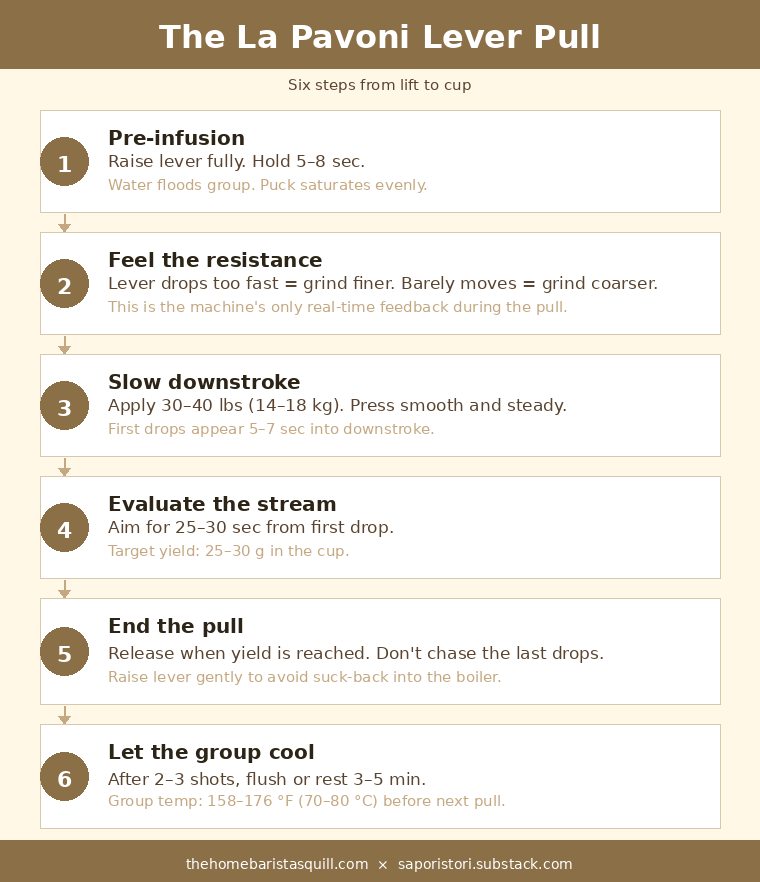
Lift the lever fully and hold for 5-8 seconds. This is your pre-infusion. The puck saturates before full pressure hits it, which reduces channeling and gives you a more even extraction.
Press down slowly and steadily. Apply roughly 30-40 lbs (14-18 kg) of force. Aim for the first drops to appear within 5-7 seconds of starting the downstroke and a 25-30 second extraction from the first drop. Target yield: 25-30g in the cup.
End the pull and raise the lever gently. Don’t chase the last drops. Raising too fast pulls air back through the puck.
Geek corner
The La Pavoni boiler runs between roughly 0.7 and 1.0 bar of steam pressure. That corresponds to a water temperature of approximately 170°F to 180°F (77°C to 82°C) inside the boiler. Brew water cools as it passes through the group head, putting actual puck temperature closer to 190°F to 200°F (88°C to 93°C) when the machine is warmed up properly. A cold group kills the shot even when the boiler pressure looks fine, which is why the flush in step 2 matters more than it seems.
If you’re working out the Jolly’s stepped adjustment range, the same principles in this breakdown of what grinder settings are actually telling you apply directly to a stepped flat-burr system.
What changed when I stopped fighting it
Sapori Stori
Somewhere between the exploding portafilter and the endless grinder adjustments, I stopped seeing the La Pavoni as an opponent.
The shift didn’t happen with a perfect shot. In fact, I’m still chasing that. It happened one morning when I realized I was no longer rushing through the process. Instead of treating the machine like an obstacle standing between me and my coffee, I started to enjoy the ritual itself: filling the boiler, grinding the beans, watching the pressure rise, and paying attention.
Growing up, I thought my father loved espresso because of what was in the cup. Now I think he loved everything that happened around it. The weighing of the coffee, the tamping, the repetition. The small acts of care that transformed a sleepy morning into the opening notes of the day’s symphony.
Living in Italy taught me that many of the best food traditions are not built around convenience. Nobody praises the moka pot because it’s fast. Nobody spends Sunday making ragù because it’s easy. The value comes from participation. The ritual is part of the reward.
Learning to make espresso taught me that the final cup is only the visible part of the process. Behind it are countless small decisions: the bean, the roast, the grind, the technique, and the people who shaped each step along the way.
Just as every espresso begins long before the pull of the lever, every flavor has a story that begins long before it reaches the cup or the plate.
What the machine keeps teaching
Jim Morales
Switching to a La Pavoni lever espresso machine takes longer than switching between two pump machines. The first week produces shots that confuse you. The second week produces shots that mostly make sense. By the third week, you start reading the machine: the pressure gauge before the first pull of the morning, the resistance change when the group hits the right temperature, and the sound the lever makes when the grind is dialed.
That feedback loop is what keeps people using these machines for decades. The shot in the cup is yours in a way a programmable semi-automatic can’t replicate. Not because it’s harder. Because it asks something of you, and when you give it, you can taste the difference.
Listening while you brew: “Mattinata” by Andrea Bocelli Spotify:
If writing like this is useful to you, a paid subscription is what keeps it going. This piece came out of real back-and-forth with Sapori Stori about what the first weeks on a lever machine actually feel like, and that kind of collaboration takes time to do right.
What did your first week on a new machine teach you that no guide prepared you for? Lever or pump, I’m curious what surprised you.
If you know someone circling a La Pavoni purchase or sitting with one that isn’t clicking yet, send this their way.
Warmly,
Jim
Pull, Quill, Pour Stories
 | A guest post by
|
Loved this collaboration! It was such a pleasure to work with you!
Wow… having my experience with a Flair, I fully empathize with the process and frustration. No, it’s not a super-automatic machine, but like her father experienced, it’s more than just the end result. It’s everything that goes into it that makes the coffee’s enjoyment that much more enriching. I love the statement, “Every variable that a modern semi-automatic handles automatically, the La Pavoni hands back to you.”