

Why Your Espresso Grinder Matters More Than Your Machine: Precision Over Price
A precision espresso grinder is your secret weapon. Learn why grind consistency unlocks exceptional espresso before machine upgrades ever will

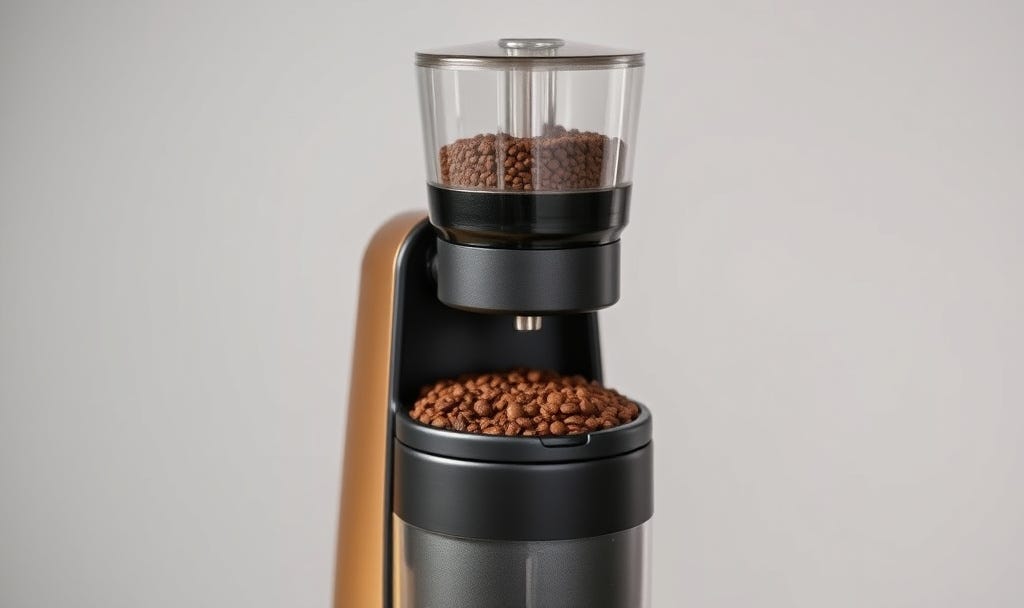
The Espresso Reality Most Baristas Ignore
Walk into a home barista’s kitchen, and you’ll likely see a machine that costs them $1,500–2,000. Then look at their grinder. Often, it’s a $100 budget model they bought without much thought. The result? Mediocre espresso, regardless of how much was spent on the machine. This backwards priority haunts countless home baristas. They blame their technique. They blame their beans. Not only that, but they also consider replacing their machine. But the real bottleneck sits silently on the counter: a grinder that can’t deliver the particle uniformity espresso demands.
A precision espresso grinder, one engineered specifically for espresso’s exacting requirements, transforms everything downstream. It makes dialing in possible, rather than impossible. It makes consistency achievable instead of accidental. Likewise, it makes exceptional espresso inevitable, not aspirational.
Why Espresso Is Unforgiving: The Particle Size Problem
Espresso lives in extremes. Unlike pour-over, where variable grind sizes are forgiving, espresso requires exact uniformity.
Consider what happens in your portafilter: 18–20 g of grounds compressed tightly, water forced through at 9 bar pressure for 25–35 seconds. Extraction depends entirely on whether water can flow evenly through the puck.
If grind size varies:
Fine particles create mud that blocks water flow; channels open, and water rushes through unextracted.
Coarse particles resist extraction, leaving flavor behind.
Result: Sour, thin shots or bitter, heavy ones. Never balanced.
A refined espresso grinder keeps particle distribution so tight that variation is negligible. Every ground extracts at nearly the same rate. Water penetrates uniformly. Extraction becomes predictable, and flavor becomes transparent instead of muddy.
A grinder that can grind fine but lacks precision engineering produces the opposite effect. Inconsistent particle size masquerades as “difficult espresso” when really, the equipment is sabotaging you.
Engineering Excellence: Why Professional-Grade Costs More
Budget espresso grinders cut corners. Professional-grade espresso grinders invest in precision because fine grinding under pressure demands it.
The difference lies in:
Burr construction: Precision-engineered conical or flat burrs aligned to near-zero play, maintaining consistency across 10,000+ grinds.
Motor stability: Engineered for sustained high-speed operation without vibration, which degrades uniformity.
Adjustment precision: Micrometric systems offer 30–100+ discrete grind positions, enabling micro-tweaks between single shots.
Retention design: Minimal old grounds residue contaminating fresh pucks, ensuring every dose tastes current.
Static reduction: Advanced features minimize fines (powder-like particles) that clog pucks and cause channeling.
Budget models skip these engineering investments. The result: wobble, inconsistency, frustration, and a false belief that espresso is inherently difficult. It’s not your grinder that is the limiting factor.
Key Tip: Listen to demo videos before buying. Smooth, steady grinding noise indicates robust burr alignment. Chattering or grinding sounds indicate poor engineering and inconsistent results ahead.
Dialing In: From Struggle to Science

Dialing in with an underpowered grinder feels like solving a puzzle where the pieces keep changing. You adjust, pull a shot, and improve it. Next shot with identical settings? Different flavor. Frustrating, then demoralizing.
With a robust espresso grinder, dialing in becomes methodical and fast.
Pull a shot. Runs too quickly (sour, thin body)? Adjust the grind slightly finer; the next shot improves noticeably. Runs too slowly (bitter, heavy-bodied)? Adjust coarser; the next shot brightens. The relationship between grind size and extraction becomes immediate, obvious, and repeatable.
Within 10–15 shots, you’ve found your sweet spot. By 50 shots, you understand your machine’s personality. At 100 shots, you’re pulling consistent, balanced espresso that tastes how the roaster designed it: sweet, complex, syrupy, with crema that clings.
This progression transforms espresso from a frustrating mystery into a learnable craft. Each shot becomes intentional. You’re not fighting your equipment; you’re collaborating with it. That psychological shift—confidence replacing doubt—makes the grinder investment invaluable.
Flavor Revelation: When Espresso Finally Tastes Right
Poorly dialed espresso tastes generic. Maybe bitter, perhaps sour, possibly forgettably flat.
Properly dialed espresso enabled by a dependable espresso grinder tastes specific. A single-origin Ethiopian tastes bright, fruity, and floral. A naturally processed Brazilian tastes chocolate-forward and sweet. A blend reveals distinct component beans rather than a muddy blend.
This transparency emerges from uniform extraction. When particle sizes are consistent, every ground dissolves at roughly the same rate. Bright notes don’t get buried under bitterness. Sweetness doesn’t hide under sourness. Complexity surfaces where confusion lived before.
Most baristas experience this moment and attribute it to technique. Really, it’s the grinder finally providing the foundation that makes technique matter. The difference between a $100 grinder and a $500 grinder isn’t subtle; it’s the difference between struggling and succeeding, between confusion and clarity.
Consistency: The Overlooked Superpower
Here’s what separates high-performance espresso grinders from mediocre ones: they deliver the same result repeatedly.
Pull a shot at a specific grind setting. It tastes balanced and sweet. Note your settings. Pull another shot with identical settings. It tastes identical. This reproducibility sounds obvious, but it revolutionizes espresso for anyone upgrading from a lesser grinder.
Consistency enables:
Dialing in once and trusting the dial stays dialed.
Adjusting one variable and predicting the outcome.
Comparing different beans without wondering if the grinder introduced hidden variables.
Teaching technique to others because results are reproducible, not random.
Building intuition through pattern recognition instead of guessing.
Over time, consistency compounds into mastery. You understand your grinder so intimately that you dial in within 3–5 shots. You adjust grind size in single microsteps and taste the difference. Confidence replaces doubt because your equipment supports it.
Investment Reality: Why Premium Costs Less Than It Seems
A precision-engineered espresso grinder costs $400–800. Expensive, yes, until you calculate per-shot cost.
Over five years of daily espresso, that’s roughly $0.27–0.44 per shot. Compare that to:
Wasted beans during endless dialing-in attempts with an underpowered grinder.
The cost of upgrading machines because you are mistakenly thinking that equipment is the bottleneck.
Replacing budget grinders every 18–24 months as burr performance degrades.
The emotional cost of frustrated, mediocre shots month after month.
A quality grinder, properly maintained, works reliably for 5–8 years. Burr replacement kits extend lifespan further. The long-term cost per shot becomes trivial compared to the payoff: a daily espresso that tastes exceptional and consistent.
Key Tip: Own one excellent espresso grinder and master it rather than cycling through cheaper models every couple years. Mastery is an investment that compounds; starting over repeatedly does not.
What Defines an Excellent Espresso Grinder
Look for grinders explicitly designed for espresso, praised across specialty coffee forums for fast dialing in and consistency. Popular, well-engineered options include the Baratza Sette 270 (legendary espresso precision), the Eureka Mignon Specialita (flat burrs, touchless dosing), the Niche Zero (single-dose minimalism, near-zero retention), and hand grinder alternatives like the 1Zpresso JX for manual enthusiasts.
Research specifically mentions espresso performance: Do users dial in within 5 shots? Do espresso pulls look syrupy and visually uniform? Does the grinder hold settings reliably between batches? These matter infinitely more than price, brand prestige, or flashy displays.
What was your espresso breakthrough moment after switching to a precision-engineered grinder?
How much faster did your dialing-in timeline improve after upgrading your espresso grinder?
Warmly,
Jim
Pull, Quill, Pour Stories
I admire this post. I have a Breville burr grinder that seems to work fairly well for a home setup. You’re 100% right. It all starts with the grind.