

Cold Start vs Hot Start: Why Your Grinder Stalls (and How to Fix It)
Is your grinder stalling on light roast beans? It's probably not the motor. Here's why hot-starting fixes it, and when cold starts still work fine.

You load the hopper, flip the switch, and the motor groans instead of spins. Maybe it stalls outright. You check the burrs, you check the grind setting, and you start eyeing a replacement grinder. But the fix usually has nothing to do with the hardware you own. It’s the order you turned things on.
That’s the whole story behind cold start vs hot start grinder debates: whether you power the motor up before or after beans hit the hopper. Get the order backward, and even a solid grinder chokes on light roast. Get it right, and the same machine runs clean.
Why Grinders Stall on a Cold Start
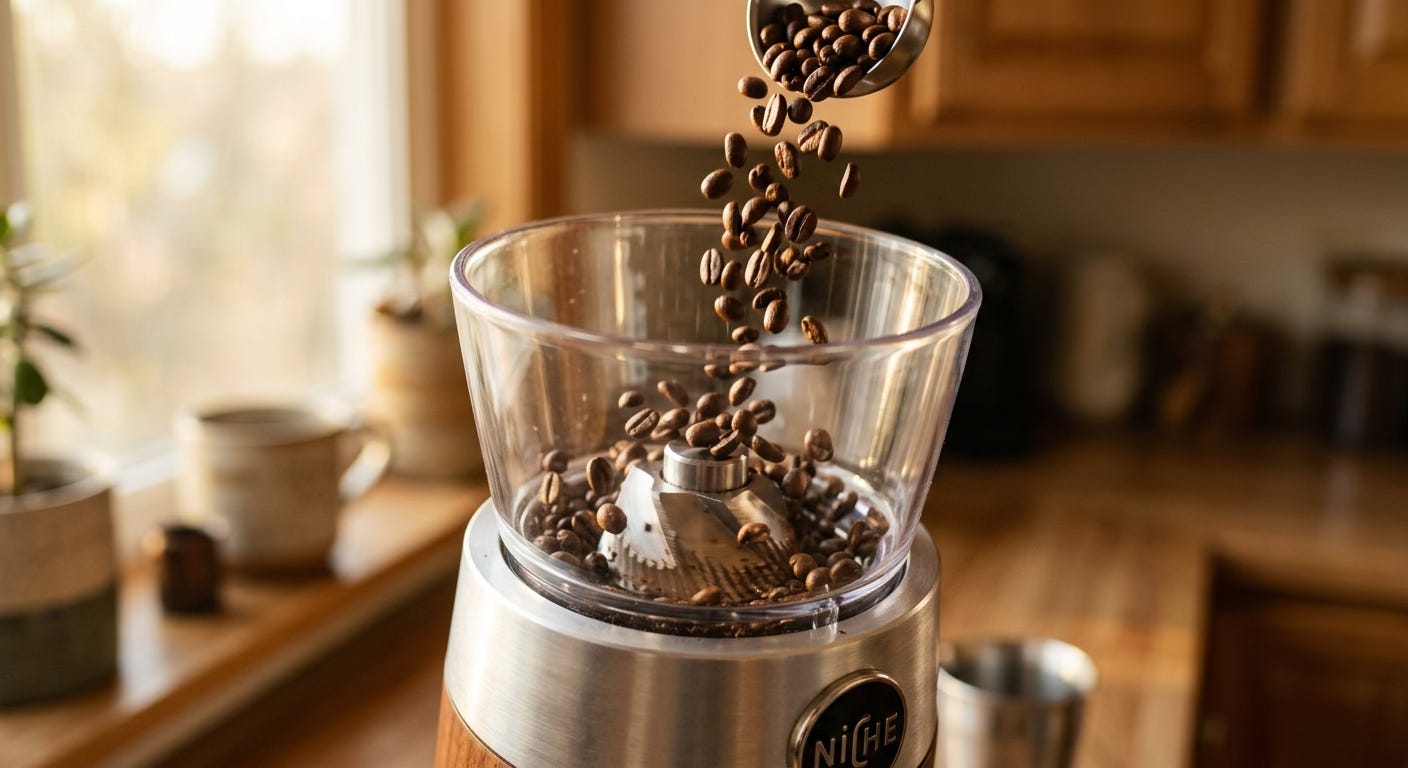
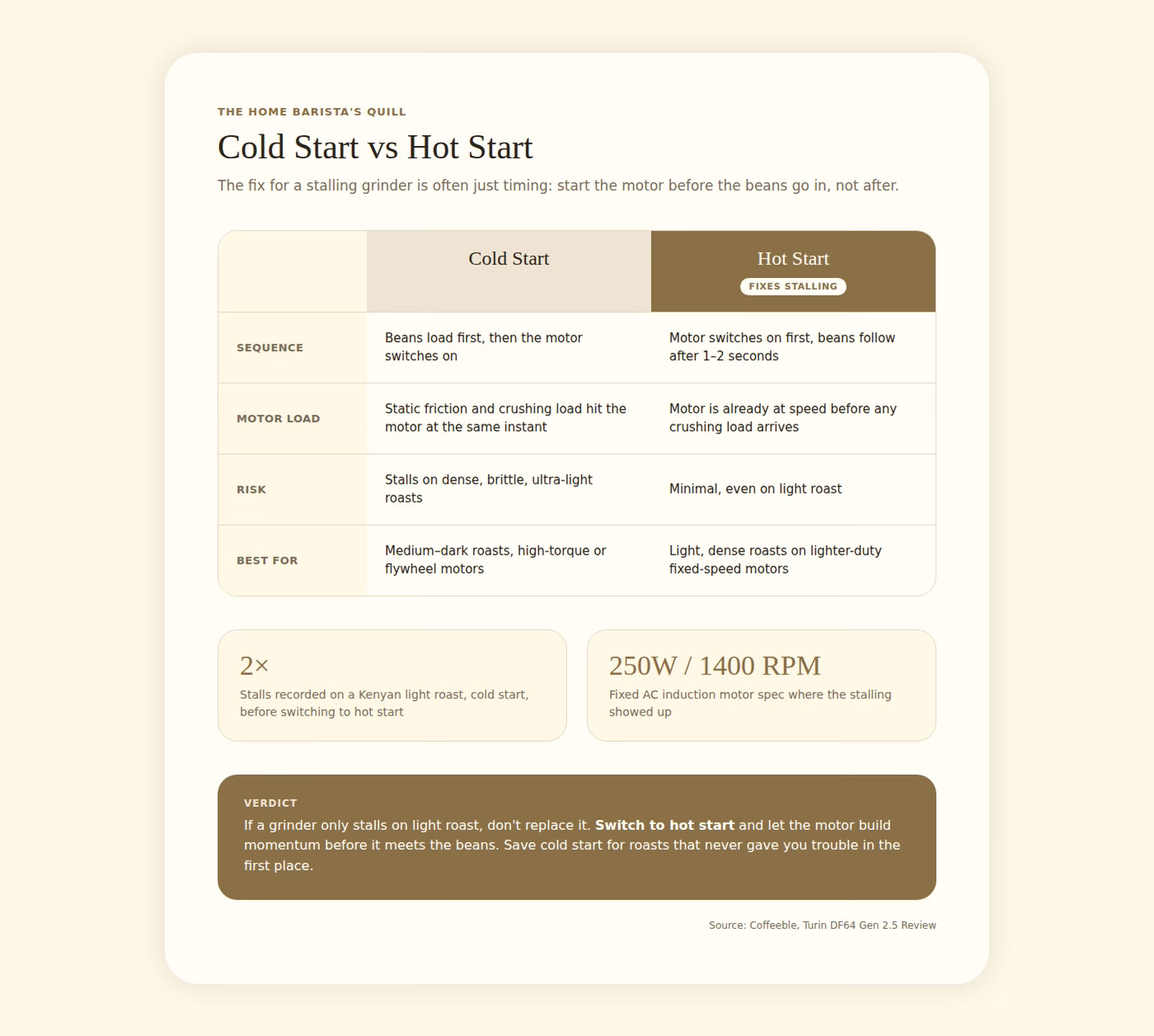
A cold start means you drop beans into the hopper first, then flip the switch. The motor has to do 2 things at once: break static friction to get the rotor moving at all and immediately start crushing bean matter. On a dense medium or dark roast, most motors shrug this off. On an ultra-light roast, especially one with a harder bean structure, that combined load is enough to stop the motor cold.
A hot start flips the sequence. You turn the motor on first, let it spin empty for 1 to 2 seconds, then feed beans in through the hopper or an anti-popcorn device. By the time beans reach the burrs, the motor’s already at speed. It’s carrying momentum instead of starting from zero, and that momentum is what gets it through the dense pockets that would’ve stalled a cold start.
The Coffeeble review of the Turin DF64 Gen 2.5 documents this directly: a 250W AC induction motor fixed at 1400 RPM stalled twice on a Kenyan light roast at espresso-fine settings, cold start. Switching to hot start solved it. The motor’s flywheel-like rotor carries enough rotational mass to push through dense bean chunks once it’s already moving; it just can’t build that momentum and crush beans in the same instant.
If you’ve read Grinder Ticks: Map Time to Precision, you already know grind time is a variable worth tracking. Stalling throws that variable out entirely, since a stalled motor gives you an incomplete, uneven grind instead of a predictable one.
When Cold Start Still Works Fine
Not every grinder needs a hot start, and not every roast punishes a cold one. Grinders with heavier flywheels or higher-torque motors, including many variable-speed brushless models, build momentum fast enough that starting under load barely registers. Medium and dark roasts are also more forgiving: they’re less brittle and denser under the burr, so the load spike at the start is smaller to begin with.
The grinders that actually require a hot start are lighter-duty fixed-speed motors paired with ultra-light, dense roasts, exactly the combination that stresses a motor at the moment it has the least momentum to work with. If your grinder handles cold starts fine on your usual beans, there’s no reason to change your routine. Save the hot start for the roasts that give you trouble.
This is the same logic that shows up in Why your espresso shot and a perfectly seared steak follow the same rule: respect the variable actually in front of you instead of applying one fix to every situation.
Geek Corner
Static friction (the force holding a stopped rotor in place) is higher than kinetic friction (the force acting on a rotor already spinning). That gap is why the first fraction of a second after flipping the switch is the hardest moment for any motor, cold start or not. Add a crushing load moreover gap, and you’ve stacked two demands on the motor at its weakest instant. (Source: Coffeeble Turin DF64 Gen 2.5 Review)
If a grinder stalls on you, check the cold start vs hot start grinder sequence before you blame the hardware. It’s a 5-second habit change, not a purchase.
Does hot starting wear out a grinder motor faster?
No. Letting a motor reach full speed before the load hits it is easier on the motor, not harder. It’s the cold-start combination of static friction and immediate crushing load that stresses a motor most.
Is cold start ever fine to use?
Yes, for medium to dark roasts on most motors, and for any grinder with enough torque or flywheel mass to absorb the initial load. Reserve hot start for grinders or roasts that actually stall.
Why does my grinder only stall on light roast?
Light roast beans are denser and more brittle than dark roast beans, which means more resistance at the burr the instant grinding starts. That extra resistance is what pushes a marginal motor from struggling to stalling.
Listening while you brew: “Rose rouge” by St Germain
It eases in on a groove before it commits, the same patience a hot start rewards.
Spotify:
Next time your grinder stalls, try the order switch before you touch anything else. Does it fix it, or is something else going on?
If you know someone nursing a grinder they’re convinced is broken, send this their way before they replace it.
Warmly,
Jim
Pull, Quill, Pour Stories
Are you aware that your text scans as 100% Ai assisted ?